sgcUI Included with every sgcUI edition

sgcLocalization. One translation editor. One line at runtime.

Ship your application in every language your customers speak. sgcLocalization finds the texts of your forms, frames and data modules, gives you one editor to translate them by hand, with professional translators or with AI, checks every translation and switches the whole application at runtime with one line of code.

  • VCL
  • FireMonkey
  • LCL
  • Delphi 7 to 13
  • C++ Builder
  • Lazarus
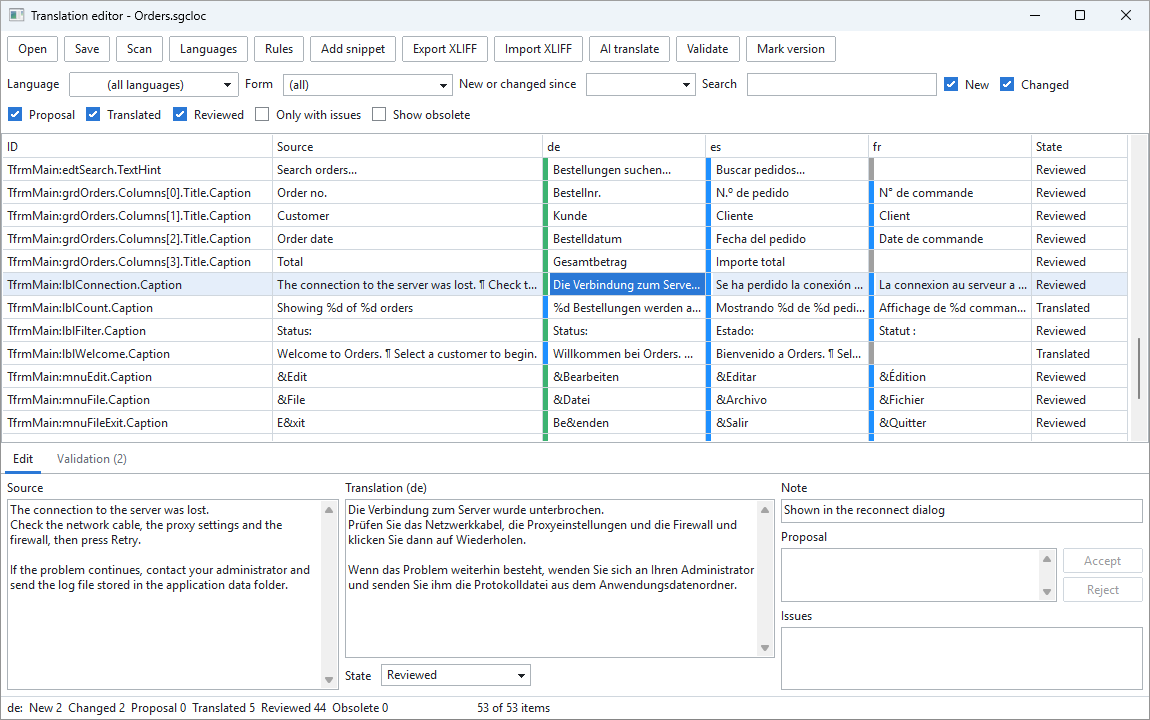
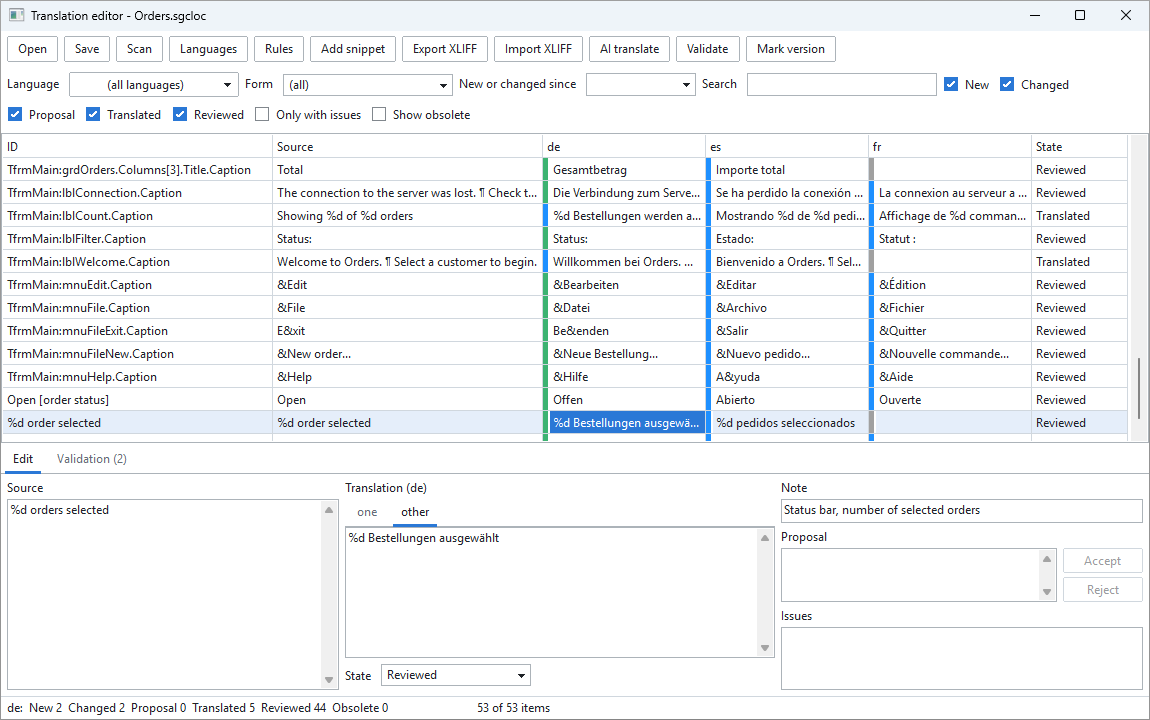
The sgcLocalization translation editor with a project open: source texts with German, Spanish and French columns, item states and the edit panel
  • RTTIForms, frames and data modules are scanned through RTTI
  • XLIFFEvery import is reviewed before it is applied
  • CLDRPlural forms with CLDR rules
  • sgcTsgcT for text created in code, with context and plural variants

From the First Scan to the Next Release

sgcLocalization covers the whole job: collecting the texts, translating them, checking them, switching the language at runtime and keeping the translations up to date when the application changes.

  • Finds your texts

    Every text property of your forms, frames and data modules is found for you.

  • One translation editor

    Translate by hand, exchange XLIFF files with translators or let an AI service propose the texts.

  • One line at runtime

    sgcSetLanguage('de') switches the whole application, with no restart.

  • Included with sgcUI

    No extra cost: it comes with every sgcUI edition and every single product.

See it run.

The texts of your application in one project, and one editor to translate them.

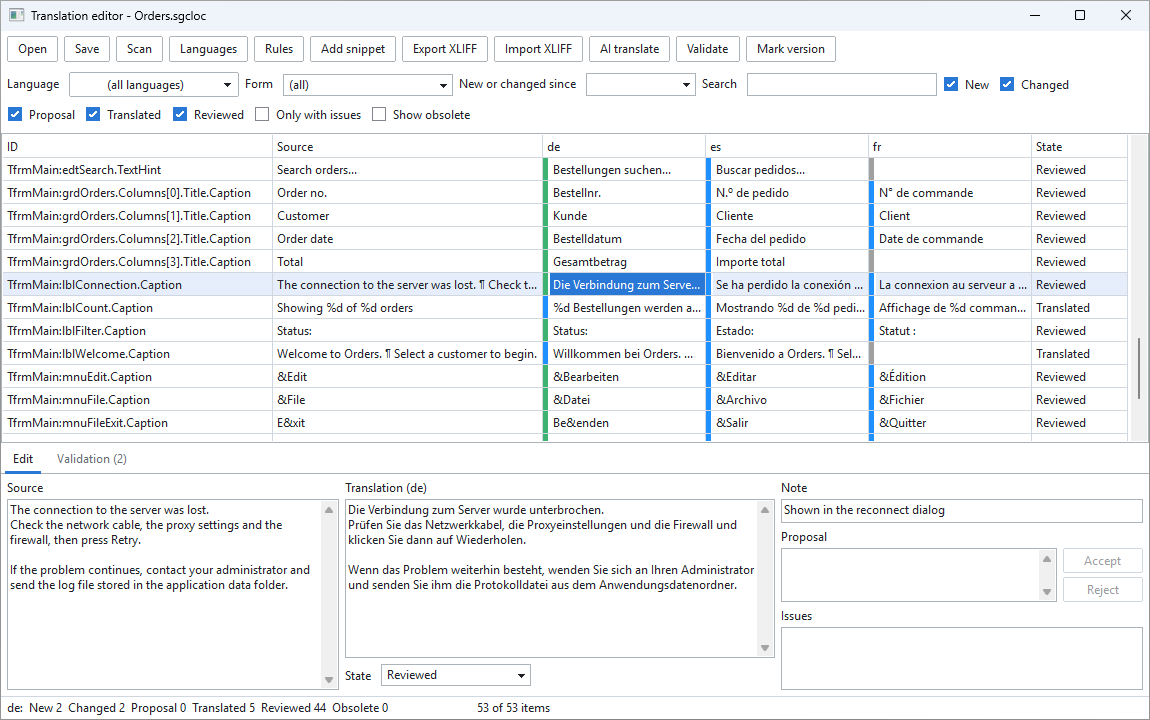
Translation editor listing the text properties found in a form, such as captions, hints and column titles, with one column per language
Collect and translate

It finds the texts, you decide what is translated

  • sgcLocalization reads your forms, frames and data modules through RTTI and lists every text property it finds: captions, hints, column titles, list items and the rest. Ignore rules keep out the properties that must never be translated, and the built-in defaults already cover the usual non-text properties. Text that is created in code is added explicitly as a snippet, with a context when the same word needs two translations and with plural variants when the text depends on a number.
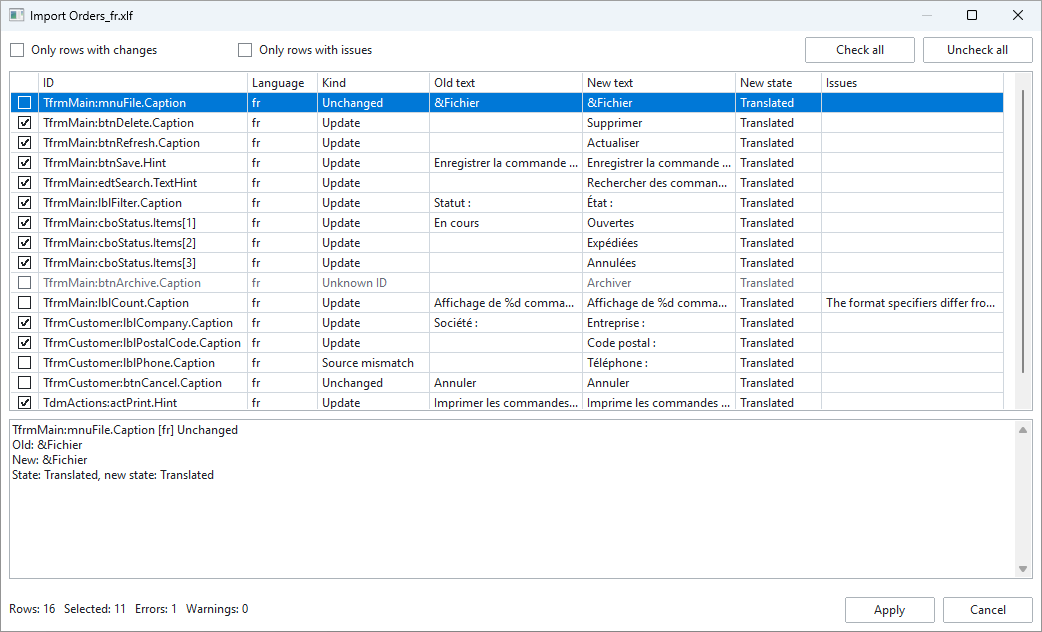
Import review dialog for a French XLIFF file: each row shows the old text, the new text, the kind of change and any issue, with a check box to accept it
Collect and translate

Work with professional translators through XLIFF

  • Export a language to an XLIFF 1.2 file, send it to your translator and import the file when it comes back. Nothing is written blindly: the import opens a review that shows, row by row, the old text, the new text and what kind of change it is. Rows with a problem, such as a format specifier that no longer matches the source, are marked, and you choose which rows are applied.
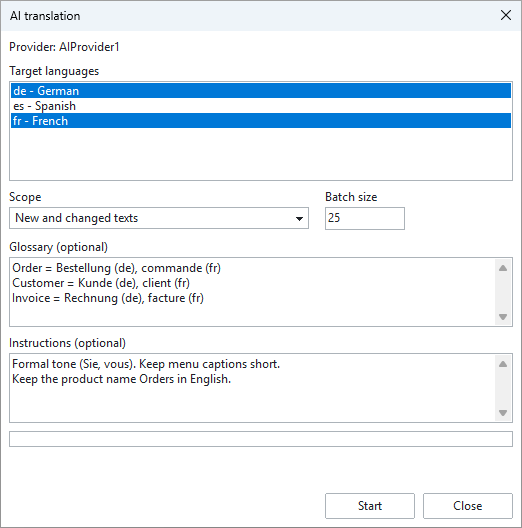
AI translation dialog: target languages, scope set to new and changed texts, batch size, an optional glossary and optional instructions
Collect and translate

AI translation that you approve

  • Let an AI service translate the new and changed texts into the languages you select, with your own glossary and instructions for tone and terminology. AI translations arrive as proposals first, next to the current text, and you accept or reject each one. The editor talks to the AI through the sgcUI AI provider. ChatGPT, Claude, Gemini, Ollama and more are available when sgcWebSockets is installed, and without it an event lets you call any service from your own code.
Translation editor with a plural text selected: the German translation has one tab for each plural form, one and other
Keep the translations correct

Validation and plural forms

  • A translation that drops a %d or an accelerator key breaks the application for the users of that language only, so it is easy to miss. sgcLocalization checks format specifiers, placeholders, accelerator keys, line breaks, leading and trailing whitespace, empty translations and plural forms. The same checks run on manual, imported and AI translations. Plural texts follow the CLDR rules of each language, so the editor asks for exactly the forms that language needs.
The sgcLocalization translation editor with a project open: source texts with German, Spanish and French columns, item states and the edit panel
Keep the translations correct

Incremental translation

  • Every item has a state: new, changed, proposal, translated, reviewed or obsolete. Mark a version when you release, and the "new or changed since" filter shows what was added or edited after it, so new text is never overlooked. Texts that were removed from the application are kept and reused as suggestions.
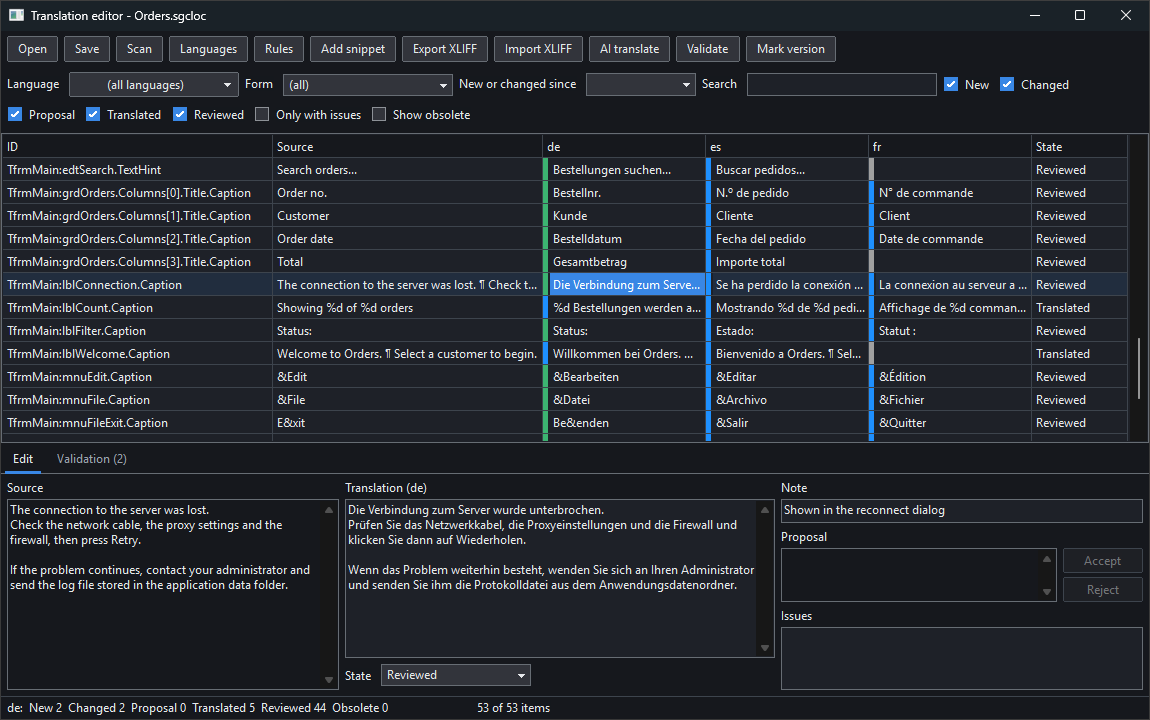
The translation editor in the dark theme
One line at runtime

Switch at runtime

  • Call sgcSetLanguage('de') or drop the ready-to-use language combo on a form. The whole application changes at once, and forms that are created later are translated automatically. Right-to-left languages also switch the layout direction.

The Code You Write

Forms are translated without code. You write one line to switch the language, and you wrap the texts that are created in code.

sgcLocalization is documented in the sgcUI help: Delphi and C++ Builder. See all features

uses
  sgcLocalization_Engine;

procedure TfrmMain.ShowSelection(aCount: Integer);
begin
  // switch the whole application to German
  sgcSetLanguage('de');

  // a text created in code
  ShowMessage(sgcT('The order has been saved.'));

  // the same word with a context, when it needs its own translation
  lblState.Caption := sgcTC('order status', 'Open');

  // a plural: the form that matches aCount in the current language
  lblCount.Caption := Format(sgcTN('%d order selected',
    '%d orders selected', aCount), [aCount]);
end;

Where sgcLocalization Is Included

sgcLocalization is not sold separately and has no price of its own. It is included at no extra cost with every sgcUI edition and with every sgcUI product bought as a single package.

Every sgcUI edition

Standard, Professional and Enterprise all include sgcLocalization.

See sgcUI pricing

Every single product

Buy one sgcUI product on its own, sgcGrid for example, and sgcLocalization comes with it.

See the single packages

Trial

sgcLocalization ships inside the sgcUI installers, so the sgcUI trial is the way to try it.

Download the sgcUI trial

Nothing extra. sgcLocalization is included with every sgcUI edition and with every sgcUI product bought as a single package. It is not sold separately.

Explore sgcUI

Works with the rest of sgcUI.

The sgcUI controls already carry their own texts in 12 languages. sgcLocalization adds the texts of your own application.

Try sgcLocalization Today

The sgcUI trial includes sgcLocalization and every other sgcUI product.

Latest from the blog

View all posts →

You are seeing the sgcLocalization view of eSeGeCe.

Show me another angle →
30-Day Money-Back GuaranteeNot satisfied? Request a full refund within 30 days of purchase. See refund policy